

Opening Bell – Why This Matters
Financial markets are living, breathing systems. They are made up of millions of participants — investors, traders, institutions — each with their own motives, strategies, and reactions to news. Like weather systems, they are complex, adaptive, and often unpredictable.
In such an environment, Computational Science becomes a powerful ally. By combining mathematics, computer science, and domain expertise, it allows us to model, simulate, and analyse these systems in ways that would be impossible through direct experimentation.
This report focuses on two complementary tools for navigating the markets. The first is a Financial Market Prediction (FMP) model, which forecasts market direction using historical data. The second is a Decision Support System (DSS), which helps investors make informed buy, hold, or sell decisions by combining multiple data sources.
Two Routes to the Bullseye
Although both FMP and DSS aim to help investors, they take very different approaches.
FMP is like a weather forecast for the market. It looks at historical price patterns, applies technical analysis, and tries to predict where prices will go next. DSS is more like a personal financial advisor. It does not just look at charts, it considers fundamentals, analyst opinions, and even investor psychology, weighing them all before making a recommendation.
Both approaches rely on time series data, which are sequences of data points over time, but they interpret it differently. Technical analysis focuses on price and volume patterns, while fundamental analysis looks at company health, such as earnings and valuation ratios.
Data Dividend – Gathering the Clues
The models in this report draw their information from the Alpha Vantage API, a reliable source for historical prices, trading volumes, analyst ratings, and company fundamentals.
Data collection is not without challenges. While price and volume data are abundant, integrating fundamental and macroeconomic indicators adds complexity and potential quality issues.
Riding the Trend – Financial Market Prediction (FMP)
The FMP model in this study uses one of the oldest and most trusted technical indicators, the Moving Average (MA).
The Simple Moving Average (SMA) smooths out price data by giving equal weight to all observations. The Exponential Moving Average (EMA) gives more weight to recent prices, making it more responsive to changes.
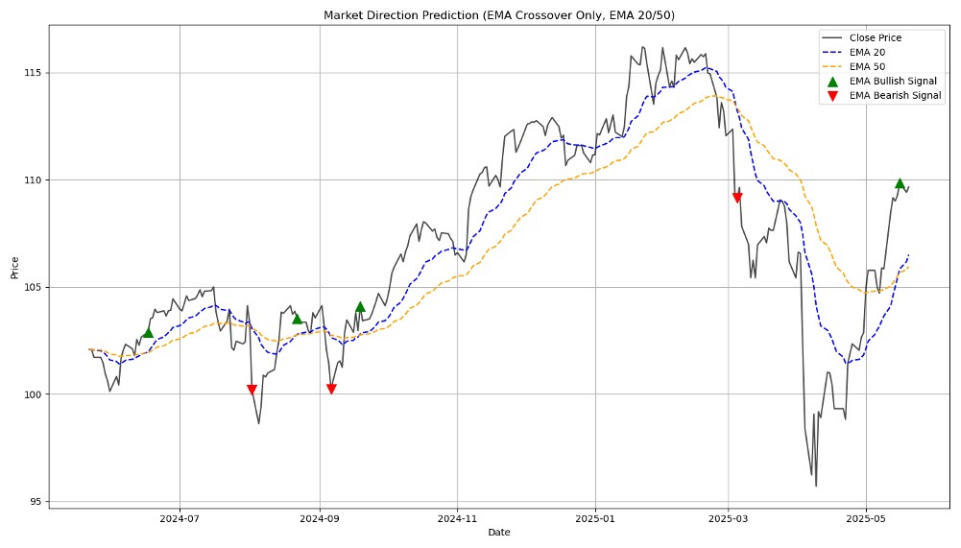
The chosen method is the EMA crossover strategy. When a short-term EMA crosses above a long-term EMA, it produces a bullish signal known as the Golden Cross. When it crosses below, it produces a bearish signal known as the Death Cross.
Baseline Breakout – The Basic Model
The basic model uses a 20-day short EMA and a 50-day long EMA. It predicts market direction based on crossover points.
Example Result:
Volume Confirmation – The Advanced Model
The advanced model uses shorter EMAs for faster signals and adds a volume confirmation filter. This means it only acts on signals when trading volume is above its moving average, reducing false positives.
Example result:
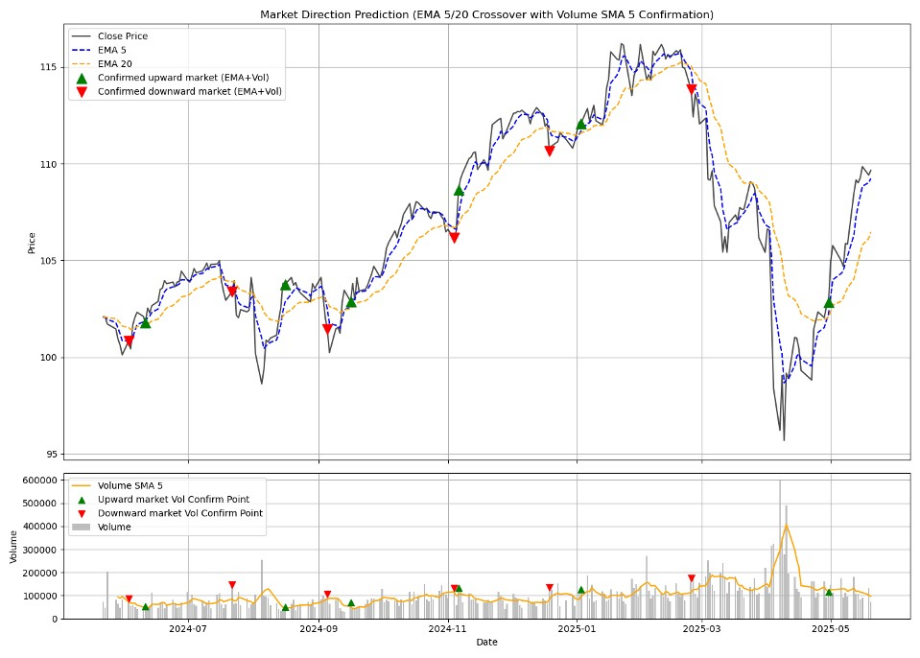
The basic model works but lags behind actual market turns. The advanced model improves timeliness and filters out noise, but still cannot escape the inherent lag of moving averages.
Buy, Hold, or Sell? – Decision Support Systems (DSS)
While FMP focuses on trend prediction, DSS focuses on decision-making.
The DSS in this report evaluates three key metrics, the PE Ratio, which is a valuation measure where lower is better for buyers; the EPS, which is a profitability measure where higher is better; and the Analyst Rating, which is aggregated and normalised from multiple analyst recommendations.
Hard Stops – The Basic DSS
The basic DSS uses fixed thresholds to classify each metric as good, acceptable, or poor. It then averages the scores to produce a buy, hold, or sell recommendation.
Example Output:
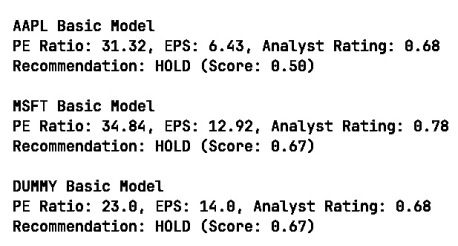
The limitation of this approach is that it is binary and rigid. A stock just below a “good” threshold might be unfairly downgraded.
Reading Between the Lines – Fuzzy Logic DSS
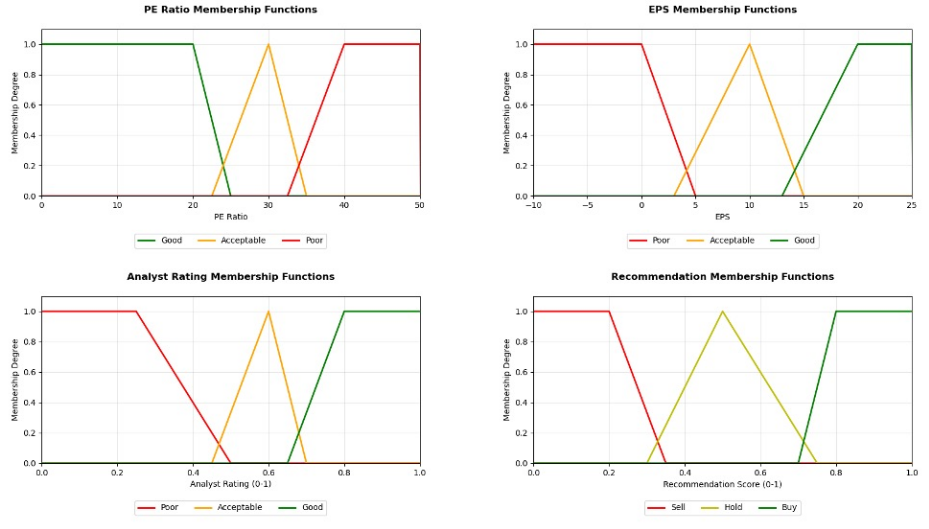
The advanced DSS introduces linguistic categories like “somewhat good” or “slightly poor.” It uses membership functions to allow partial belonging to multiple categories. The inputs are processed through 27 rules that mimic human reasoning, producing a nuanced recommendation with confidence levels.
Membership Overlap:
Example Output:
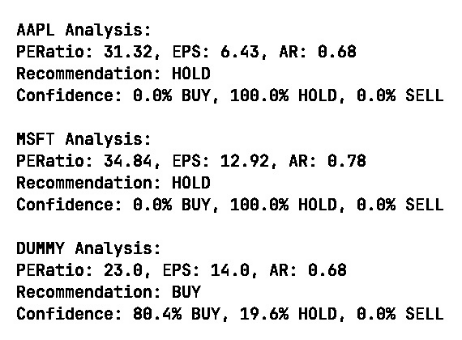
The fuzzy model can turn borderline “hold” cases into justified “buy” recommendations by recognising partial strengths. However, it is more computationally expensive, with complexity growing exponentially as more metrics are added.
Balancing the Portfolio – Comparative Insights
The FMP is efficient and scalable with a complexity of (O(n)), making it suitable for large datasets and quick trend checks. However, it is reactive and confirms trends rather than predicting them early.
The DSS, especially the fuzzy version, is more like a deep thinker. It can handle uncertainty and nuance, but at the cost of speed and scalability. In real-world use, it would need optimisation to handle more than a few metrics.
Together, they could form a powerful hybrid, with FMP detecting potential opportunities and DSS evaluating whether those opportunities are worth acting on.
Closing Bell – Conclusions
This study showed that EMA crossover remains a valid, interpretable method for market trend confirmation. Volume filters can improve accuracy by reducing false signals. Fuzzy logic DSS offers more human-like, adaptable recommendations than rigid rules. The trade-off is between speed and nuance, with FMP being fast but blunt, and DSS being slow but precise.
Future work could explore zero-lag EMAs to reduce signal delay and rule optimisation in DSS to cut complexity without losing nuance.